
March 10, 2026
Beyond the Hype: How Apple Intelligence is Quietly Dominating the AI Landscape
While the rest of the tech world has been locked in a race to build the largest, most power-hungry cloud models, Apple has been playing a different game. By focusing on the hardware in your pocket rather than the servers in a warehouse, Apple is transforming AI from a novelty chatbot into an essential, local utility. While competitors are burning billions on inference costs, Apple is building an AI nervous system directly into its custom silicon.
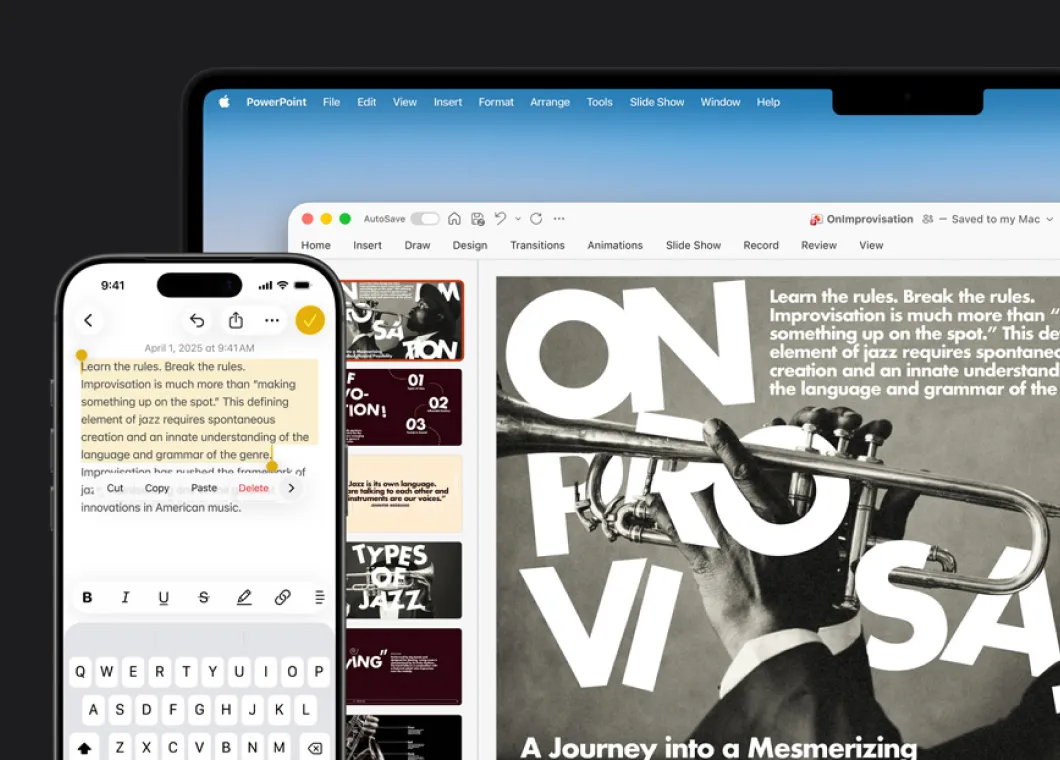
The most significant advantage in the AI era isn't just code, it’s distribution. Apple commands an ecosystem of over two billion active devices. While startups fight for user acquisition, Apple simply waits for its natural upgrade cycle.
Through the process of quantization (shrinking models to run locally), Apple can deploy advanced intelligence to more users in a single week than most software companies reach in a lifetime. By embedding Apple Intelligence into the OS, the company has created a strategic barrier that makes AI a seamless part of the user experience rather than a separate destination.
Apple’s real lead lies in its years of specialized chip design. The latest Apple M5 chip isn't just a speed boost; it is an AI-first architecture.
As of early 2026, the battle for the fastest "AI PC" has reached a fever pitch. While Windows Copilot+ PCs (using the new Snapdragon X2 Elite and Intel Panther Lake) have closed the multi-core gap, Apple’s M5 chip remains the undisputed king of efficiency and single-core responsiveness.
The M5 chip focuses on "snappiness", how fast your apps open and respond. Meanwhile, Windows machines have gone "all-in" on multi-core performance for heavy rendering.
|
Benchmark Test |
Apple M5 (26W) |
Snapdragon X2 Elite (31W) |
Intel Core Ultra 9 (Panther Lake) |
|
Single-Core (Daily Tasks) |
200 (Winner) |
146 |
130 |
|
Multi-Core (Video/3D) |
1,153 |
1,432 (Winner) |
1,285 |
Apple still wins for daily "feel." The M5 is roughly 37% faster in single-core tasks than the Snapdragon X2 Elite. However, for 3D rendering in Blender, the Snapdragon X2 Elite now beats the base M5 by nearly two minutes.
While the industry uses TOPS (Trillions of Operations Per Second) as a buzzword, the way the hardware actually uses that power matters more.
For tech enthusiasts who actually do work on their machines, these numbers translate to significant time savings:
|
Task |
Apple M5 |
Snapdragon X2 Elite |
|
4K Video Transcode (Handbrake) |
5m 14s |
3m 29s |
|
DaVinci Resolve Export |
9m 43s (Winner) |
22m 06s |
The "Mac Optimization" Edge: Notice the DaVinci Resolve score. Even though the Snapdragon chip has more raw power, Apple’s tight integration with creative software allows it to finish the task twice as fast.
The benchmarks show that Windows laptops are faster at "brute force" multi-core tasks, but they require more power (31W+) to get there. The Apple M5 achieves its scores at a lower power draw (26W), which is why the MacBook Pro M5 still gets 3–4 hours more battery life than the top-tier Windows rivals in real-world use.
A major turning point in 2025 was Apple's decision to open-source Private Cloud Compute (PCC). This move shifted AI privacy from a "trust us" model to a "verify us" model.
When a task is too complex for an iPhone, it is sent to Apple Silicon-powered servers using PCC. Unlike other cloud AI providers, PCC uses stateless computation: your data is never stored, never logged, and never used for training. Because the code is open-source, security researchers can independently verify that not even Apple can see your requests. This creates a "trust boundary" that is currently unmatched in the industry.
The AI "model wars" are rapidly commoditizing foundational LLMs. As open-source models improve, the value of any single model drops.
Apple doesn't need to build the world's most powerful LLM; it just needs to be the gatekeeper to the world's most valuable users. By integrating OpenAI’s ChatGPT and Google’s Gemini as plug-ins for broad knowledge, Apple remains the primary interface. They win regardless of which software company has the best "brain" this month, because that brain still has to live on Apple's hardware.
The intersection of specialized silicon, local execution, and verifiable privacy has put Apple in a category of its own. While others chase the hype of "Artificial General Intelligence" in the cloud, Apple is delivering Applied Intelligence in the real world. By the time the industry realizes the race has moved to the device, Apple will have already finished the lap.
Sign in with Google to join the conversation. We use it for your display name and nothing else, and your email address is never shown.
No comments yet. Sign in above to write the first one.